


Cambodia & Dossier: The Kingdom’s Textile Sector Faces an Accumulation of Risks

U.S. tariffs, LDC graduation, heat stress: in Phnom Penh, the GFT sector is seeking answers to mounting pressures that are becoming dangerously cumulative.

Nearly 300 government representatives, business leaders, trade unions, and development partners gathered on June 16 at the Raffles Le Royal Hotel in Phnom Penh for the Cambodia Textile Summit 2026. Co-organized by TAFTAC, the ILO, Better Factories Cambodia, and GIZ, with support from EuroCham Cambodia and Canada as an international partner, the summit provided an unvarnished assessment of a sector that still accounts for the bulk of the kingdom’s export revenues.
An economic engine under multiple pressures
The tone was set from the opening by the Minister of Labour and Vocational Training, H.E. Heng Sour: the sector is navigating “an unpredictable mix of trade barriers, oil shocks, and global economic instability,” compounded by reciprocal tariffs that erode export margins just as soaring oil prices increase production and logistics costs.
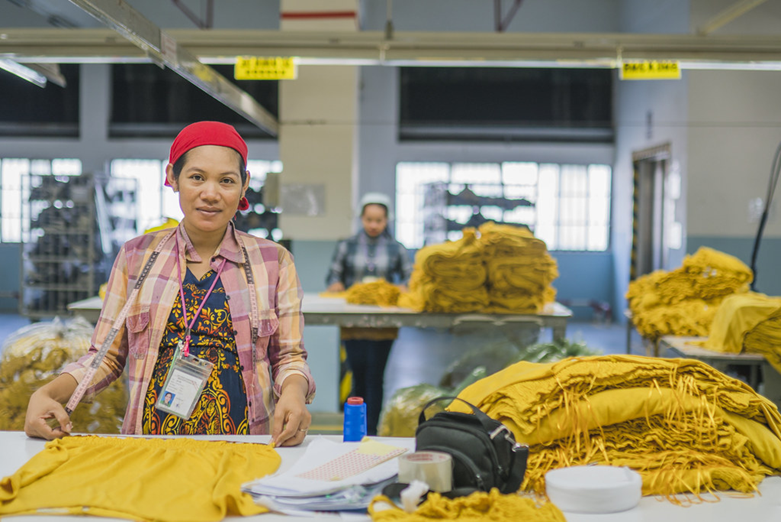
Economist Dr. Ngov Penghuy outlined the analytical framework: the GFT sector—garments, footwear, and travel goods—remains the backbone of manufacturing employment and export earnings in the country. However, Cambodia’s scheduled graduation from Least Developed Country status raises a fundamental question: how to maintain competitiveness as preferential tariff advantages fade. The answer involves moving up the value chain—dyeing, finishing, and upstream integration of raw materials—which the country has not yet fully achieved.
The Cambodia Skills Framework: structuring skills upgrading
The first panel highlighted the Cambodia Skills Framework, an initiative driven by the private sector to structure training and career progression in factories. For Dr. Ken Loo, Secretary-General of TAFTAC, the message was clear: “The factories that will succeed are those able to offer, beyond price, reliability, quality, and a workforce capable of upgrading. For the first time, this framework gives us a shared roadmap, from the shop floor to the executive office.”
TAFTAC and the Cambodian Garment Training Institute will be responsible for implementing this system, under a timeline made particularly tight by LDC graduation.
Shocks no longer add up—they multiply
The afternoon featured remarks by Martin Brisson, Executive Director of EuroCham Cambodia, who mapped increasingly interconnected risks. The situation at the Cambodia–Thailand border, U.S. tariff uncertainty, and the ripple effects of conflict in the Middle East on shipping costs are all simultaneous shocks affecting production costs and supply reliability. “These are no longer isolated disruptions that the sector can absorb individually—they strike at the same time, and they reinforce each other,” he emphasized.
Yet the figures remain resilient. GFT exports reached nearly USD 16 billion in 2025, with gradual diversification beyond garments alone. Rutger Heijsteeg, Managing Director of Maersk Cambodia, pointed to remaining opportunities: “There is a real opportunity for Cambodia to strengthen its local logistics ecosystem, particularly by reducing administrative barriers and costs related to customs and commercial documentation.”
Circularity: from waste to investment potential
The circular economy session coincided with the launch of an investment guide on textile waste management and recycling, co-developed by GIZ and TAFTAC. The assessment is stark: the volume of waste generated by the sector far exceeds national recycling capacity. But Hasso Anwer, Project Director at GIZ FABRIC Cambodia, delivered a proactive message: “Instead of talking about waste management, let’s talk about material recovery and value creation—that is the real market opportunity.” This view was reinforced by sustainability expert Massimiliano Tropeano, who highlighted growing international demand for recycled content in textile products.

Heat stress: a risk becoming a regulatory priority
Factory heat conditions featured prominently in discussions. As Cambodia finalizes a law on occupational health and safety, pressure is mounting to adapt working conditions to increasingly extreme temperatures. Froukje Boele, Country Director of ILO/IFC Better Factories Cambodia, summarized the challenge: “Progress will depend on fast and effective regulation, continuous monitoring, cost-efficient solutions, and collaboration between factories and brands.”
Social dialogue: a lever for competitiveness, not a constraint
The final panel advanced a position that contrasted with the day’s dominant economic tone: social dialogue is not a cost, but a factor of productive stability. As international buyers tighten due diligence requirements, improving working conditions in consultation with unions and government appears less as a constraint and more as a commercial advantage.
The summit concluded on a note of measured urgency. Cambodia’s textile sector has proven its ability to absorb shocks—the export figures attest to that. But the window to transform this resilience into structural strength is open, not indefinitely.

Comments