


At the ASEAN Future Forum in Hanoi, Hun Manet places peace, cooperation, and people at the heart of the regional agenda

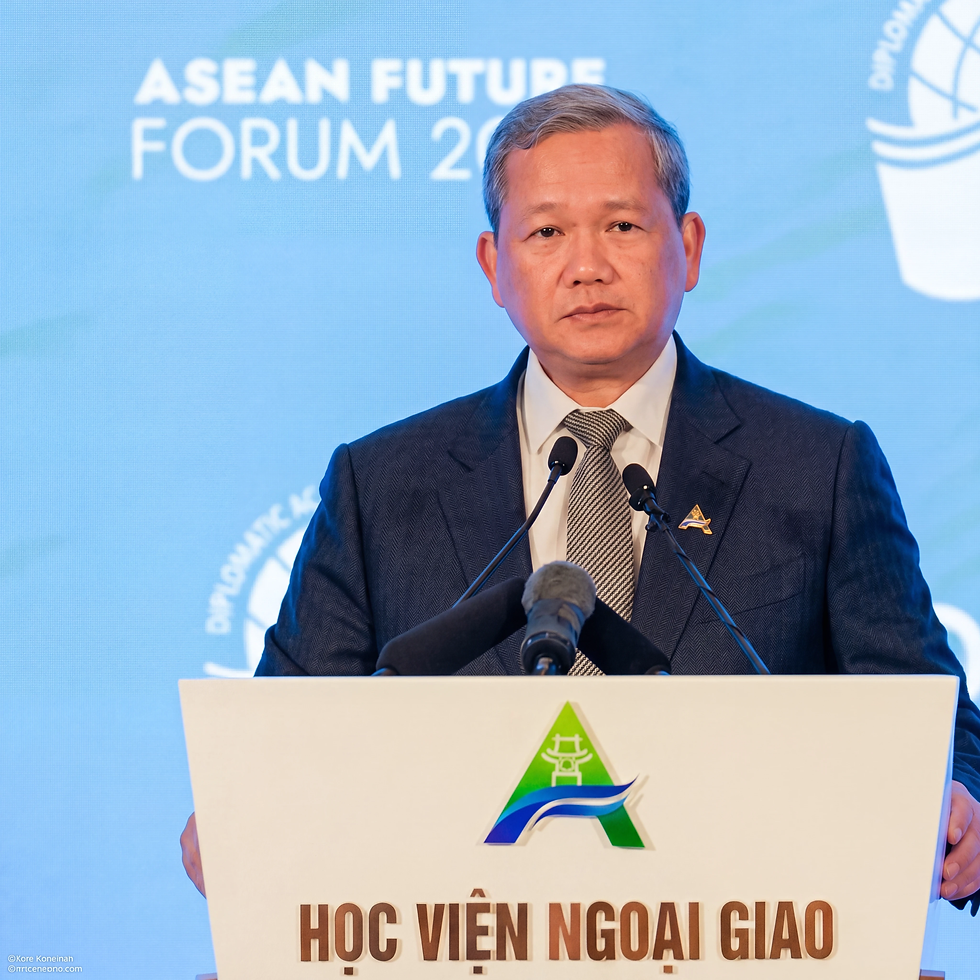
The Cambodian Prime Minister spoke on June 9 at the 3rd ASEAN Future Forum, firmly advocating for the peaceful settlement of disputes—including the border issue with Thailand—and calling on the association to measure its success by the well-being of its citizens.
An increasingly essential forum
The third edition of the ASEAN Future Forum (AFF) officially opened in Hanoi on June 9 under the theme “Shaping Our Future Together: Peace, Prosperity and People-Centered Development.” The event, which runs until June 10, is designed to generate new perspectives, initiatives, and strategic recommendations to support the ASEAN community-building process. Alongside Vietnamese Prime Minister Le Minh Hung, who presided over the opening ceremony, were the heads of government of Laos, Thailand, and Timor-Leste, as well as ASEAN Secretary-General Kao Kim Hourn.
Hun Manet arrived in Hanoi early on the morning of June 8, at the invitation of his Vietnamese counterpart, accompanied by a delegation led by Deputy Prime Minister and Minister of Foreign Affairs Prak Sokhonn. This visit—Hun Manet’s second official visit to Vietnam since taking office—is expected to strengthen bilateral relations and regional stability.
Peace: a precious and fragile asset
In his speech, the Cambodian head of government recalled the journey of Southeast Asia: a region once torn apart by ideological conflict and mistrust, gradually transformed through dialogue, respect for sovereignty, and the peaceful settlement of disputes into one of the most dynamic regions in the world.
“This transformation did not happen by chance. It is the result of deliberate choices by our leaders and our peoples, who chose dialogue over confrontation and cooperation over division,” he stated.
However, he warned that peace cannot be taken for granted. He cited ongoing tensions in the Middle East, whose repercussions on global supply chains—disruptions in energy markets and rising food prices—illustrate the principle he himself formulated: “Instability in one part of the world now affects prosperity everywhere else.”
The Thai issue: between a fragile ceasefire and recourse to international law
The Prime Minister devoted a significant portion of his remarks to the border issue with Thailand, which forms the backdrop of this regional summit. The ceasefire remains in place but is, in his own words, “fragile.” He firmly emphasized that “borders and sovereignty can never be altered by force or by fait accompli,” and called for the full and urgent implementation of the joint declaration of December 27, 2025, particularly point 3 concerning the resumption of surveying and demarcation work by the Joint Boundary Commission.
This diplomatic reminder comes within a rapidly evolving legal context. In early June, Phnom Penh officially filed a notification for compulsory conciliation under UNCLOS to resolve the maritime dispute with Bangkok in the Gulf of Thailand—an area claimed by both parties and believed to contain significant reserves of natural gas and hydrocarbons. This move followed Thailand’s unilateral termination of a 25-year memorandum of understanding intended to govern the joint exploitation of these overlapping zones.
Thai Foreign Minister Sihasak Phuangketkeow announced that Bangkok would appoint two conciliators to participate in the procedure, while expressing regret over Cambodia’s approach:
“Both parties should have first engaged in bilateral discussions.”
Reflecting controlled but real tensions, Hun Manet justified the recourse to UNCLOS as follows: “This is not a unilateral action. It is an effort to resolve the dispute peacefully, through international law and in good faith.”
In Hanoi, the Prime Minister welcomed Thailand’s willingness to engage in this UN-led process as “a welcome step” toward a lasting resolution, beneficial to both countries and to regional stability.
Economy and development: small states under pressure
On the economic front, Hun Manet painted a concerning picture for open economies dependent on global trade. He stressed that the multiple and simultaneous crises facing the world tend to push sustainable development goals down the international agenda—a reality that hits smaller states particularly hard, as they are structurally exposed to the uncertainties of the multilateral system.
Beni Sukadis, a senior analyst at the Indonesian Institute for Defense and Strategic Studies (Lesperssi), noted ahead of the forum that AFF 2026 is taking place at a pivotal moment, as Southeast Asia must simultaneously navigate strategic competition among major powers, global economic headwinds, supply chain disruptions, climate change, and the impacts of digital transformation.
The true measure of success: the people
In line with the forum’s philosophy, Hun Manet concluded his remarks on a humanistic note.
“Prosperity only has meaning when it serves the people,” he stated, urging that ASEAN’s achievements not be reduced to macroeconomic aggregates—GDP, trade flows, or investment figures. What matters, he insisted, is whether citizens “live better, more securely, in better health, and with greater hope.”
He praised the progress made by the association over recent decades—lifting millions out of poverty, expanding access to education and healthcare, strengthening connectivity, and fostering the emergence of a regional middle class—while acknowledging that rising expectations and more complex challenges require a more effective ASEAN. To meet these challenges, he called for increased exchanges among youth and academics, cultural cooperation, and media partnerships, arguing that the lack of mutual understanding among member populations remains one of the most underestimated risks to regional cohesion.
The ASEAN Future Forum is presented by its organizers as a platform for strategic innovation, where new concepts can be explored, refined, and developed before being translated into concrete action—an ambition that Hun Manet’s remarks, combining legal, economic, and philosophical dimensions, fully embodied on June 9 in Hanoi.


Comments